Scoreflection
On-device AI

Sheet music that listens back.

Play, and Scoreflection hears you. A neural transcription model turns the sound of your instrument back into notes, a score follower keeps its place bar by bar, and every notehead is marked the moment you pass it — right, wrong, missed, rushed. All of it on your phone.
95% Notes heard right
Mono + polyphonic Instruments
0 Cloud uploads
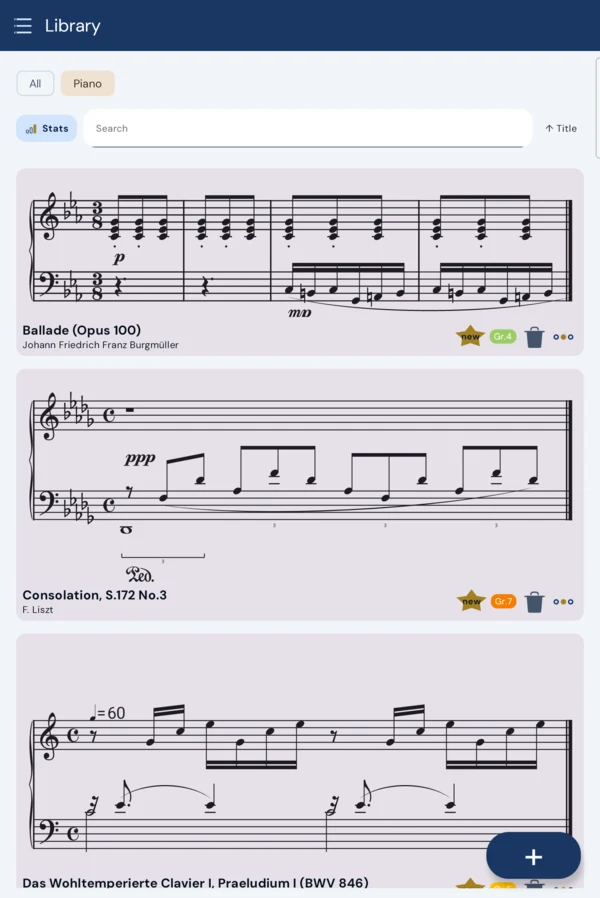
The Scoreflection library, each score shown as its opening bars.
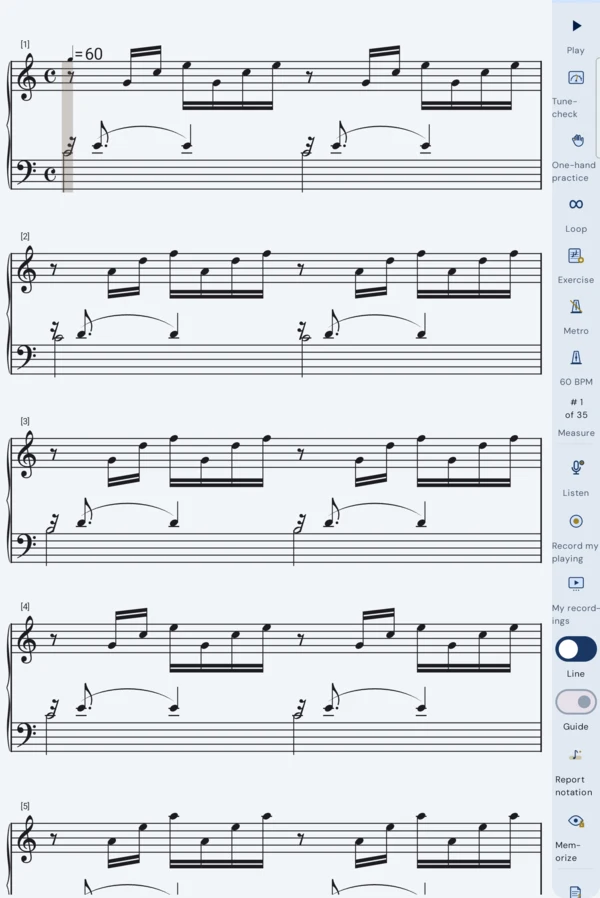
A score open in Scoreflection with the control rail out beside the music: play, tune-check, one-hand practice, loop, exercise, metronome, listen and record.
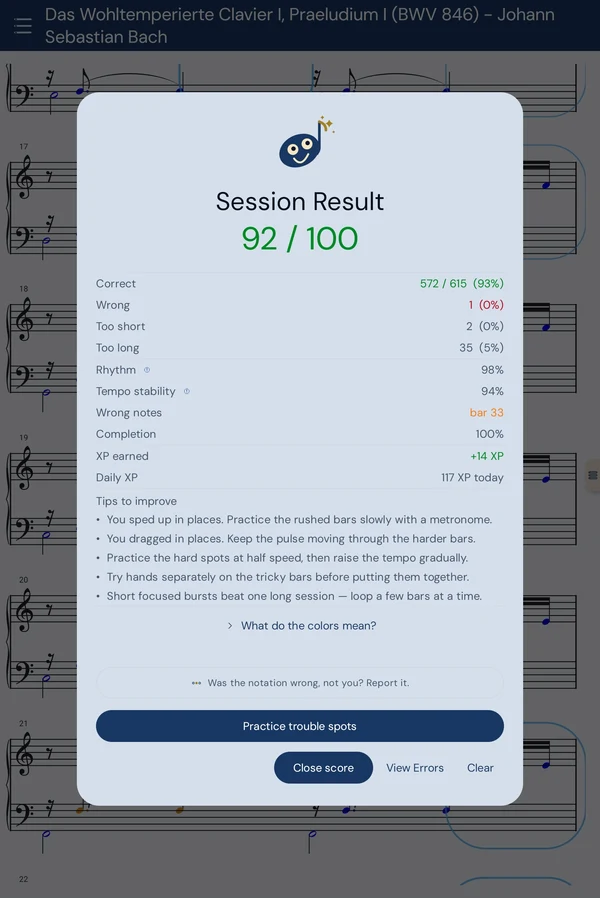
A finished session on Bach's Prelude I scored 92 out of 100: 572 of 615 notes correct, 1 wrong, 2 too short, 35 held too long, a wrong note in bar 33, and tips on what to fix.
Listening engine

Our engine doesn't just hear a pitch. It reads what you played.

Most practice apps run a frequency estimator — a tuner in a trench coat, one note at a time. Scoreflection runs a neural transcription model we trained ourselves. Raw sound goes in; real notes come out, chords and both hands included, and they get matched against the score in front of you.

  1. Listen

    Play acoustically and the microphone is enough — no interface, no pickup, no setup. Prefer wires? Plug in a USB MIDI keyboard and the engine takes that instead.

  2. Transcribe

    Our own model turns what it hears back into notes. It is polyphonic, so a six-note chord comes back as six notes rather than one confident guess — and it works on the instrument in your hands, not just on a studio piano.

  3. Follow the score

    The follower knows where you are, bar by bar. Repeats, first and second endings and a sudden D.C. al fine don't shake it — and when you lose your place and start a bar over, it finds you again instead of marking everything after it wrong.

  4. Judge

    Each note you played is lined up with the notehead it was meant to be. Octave slips are recognised for what they are, and your instrument's own overtones are thrown out before anything is held against you.

What it looks like while you play

A real take, not a mock-up: hands on the keys, and on the tablet each note takes its colour the moment the engine hears it.

Bach, Well-Tempered Clavier I, Prelude in C, played on an acoustic upright.

What your score looks like when you stop

Every note you played, marked on the page you were reading. The shape carries as much as the colour — so you can read the damage at a glance.
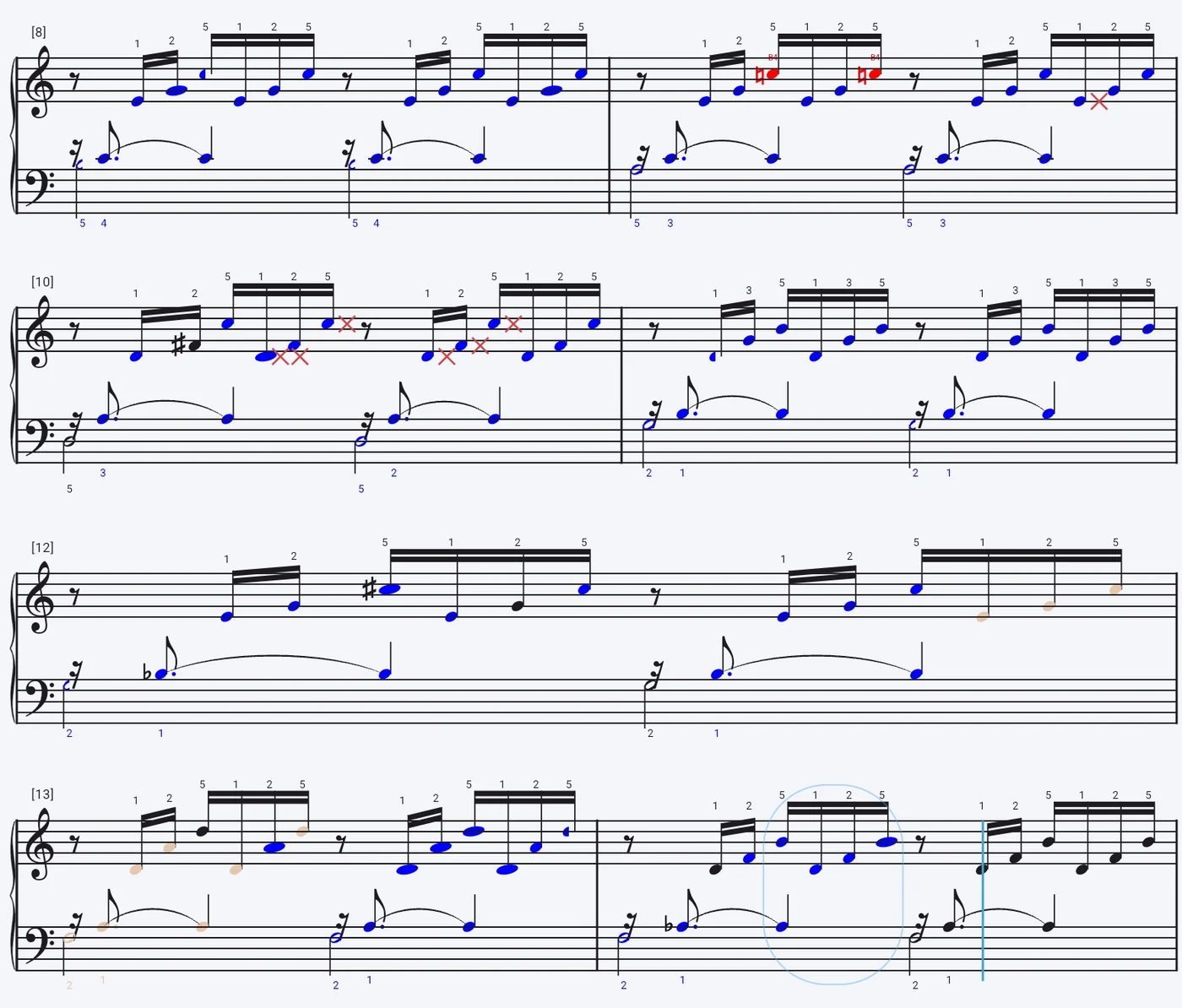
A real session on Bach's Fugue in C: most noteheads blue for correct, two red naturals where the wrong note was played, red crosses on notes that were never written, pale heads where the playing went too soft, black heads never played at all, and a circled passage that was rushed.
One real session — Bach, Well-Tempered Clavier I, Fugue in C. Nothing here was typed in by hand: the engine heard all of it.
  • Correct note
  • Correct, but too soft
  • Correct, but too loud
  • Wrong note — an arrow shows which way you missed
  • Released too early — half a head
  • Held too long — the head stretches
  • Not played — left uncoloured
  • Extra note — one the score never asked for
Features

Everything you need to practice

From the first sight-read to a polished performance — built around how you actually learn a piece.

Note-by-note verdicts

Every notehead is coloured the moment you pass it: correct, wrong, not played, too short, too long. Notes you played but never meant to appear as ghosts on the staff.

It keeps your place

The follower knows the road map — repeats, first and second endings, D.C., ornaments and ties. Jump back a bar to try again and the page is already there with you.

Microphone or MIDI

Play acoustically and let the model listen, or plug in a USB keyboard for note detection with nothing left to infer. Same feedback either way.

Tempo and dynamics coaching

It tells you to slow down while you're still rushing, marks the bars where the tempo slid, separates a recurring rhythmic tic from an honest drift, and notices when you're playing too soft to be heard.

A score, a grade, a history

Each session lands a mark out of 100 and a grade, built from pitch accuracy, rhythm, timing, tempo stability and how far you got. The notes you keep missing are remembered — and turned into your next exercise.

Bring any score

Import MusicXML, compressed MXL, MNX or LilyPond — the format is sniffed from the file, so downloads without an extension just work. Only have it on paper? Photograph the page and let the scanner have a go (currently under development!).

Also in the app

  • Practice plans. Tell it your pieces and the minutes you have; it schedules the days and stages the difficulty — one hand, then both; slow, then up to tempo.
  • Smart loops. Snap a loop to the phrase you keep fumbling, then save the session's trouble spots as an exercise you can come back to.
  • Playback. Hear any passage first, with a full General MIDI soundfont, a metronome and a voice-by-voice instrument picker.
  • Tuner. A ±50-cent meter with instrument presets, custom tunings and reference tones.
  • Annotations. Fingering (generated for you if you like it), chord symbols, dynamics, articulations and free drawing — saved with the piece.
  • Notation editor. Record from a MIDI keyboard or mic and have it transcribed, then edit, export to PDF or MusicXML, and share it.
  • Score simplification. Ask for an easier arrangement of a piece that's currently out of reach, and work back up to the real thing.
  • Ear and theory games. Interval training and rhythm echo are free — neither needs to hear you. Sight-reading flash notes, chord building and the falling-note climb judge what you actually play, so they come with a plan. All five feed the same XP and streaks.
Instruments

Piano and fretted strings, with more in the works

Choose what you're playing and the right listener is loaded for it — the polyphonic model for keys and chords, the monophonic pitch model for a single line. B♭ and E♭ instruments are transposed for you: the engine compares what you sounded against what's written.

Two families are marked supported below, and that word means measured: piano and the fretted strings have been checked against real recordings of people playing them. The others load a listener and are still being tested, so they are marked under development rather than sold as finished.

Supported
Keys
Polyphonic
  • Piano
Supported
Fretted strings
Polyphonic
  • Guitar
  • Ukulele
Under development
Bowed strings
Single line
  • Violin
  • Cello
Under development
Woodwind
Single line
  • Flute
  • Clarinet
  • Recorder
  • Alto sax
  • Tenor sax
Under development
Brass
Single line
  • Trumpet
  • Horn
Under development
Voice
Single line
  • Sing the line
Pricing

Read for free. Be heard for less than a lesson.

The library, the playback and the tuner cost nothing. What you pay for is the engine listening back — a little of it, or as much as you want.

Free
The reader
€0 / forever
  • Your whole score library, offline
  • Import MusicXML, MXL, MNX, LilyPond
  • Playback, metronome and soundfont
  • Tuner, with presets and custom tunings
  • Interval training and rhythm echo
Start free
Your personal music teacher
Practice
Everything, every day
€8 / month
  • Everything in Free
  • Graded play-along, on every piece
  • Note-by-note verdicts as you play
  • Tempo, rhythm and dynamics coaching
  • Microphone or MIDI
  • Notation editor and annotations
  • Practice plans built around your pieces
  • Session scores, grades and full history
  • Flash notes, chord builder and note climb
Choose Practice
Private by design

Nothing you play leaves the phone.

  • The model runs on your device. Microphone audio is never uploaded — there is nowhere for it to go (see diagnostics or error reports below). Practising needs no connection, on a train or in a practice room with thick walls. The listening features ask only that you are signed in, because the Practice plan is tied to your account.
  • Diagnostics are opt-in, bucket by bucket. No free-text events, uploads on Wi-Fi only, and you can export or erase everything we hold whenever you like.
  • The server exists for the things that need one. The community forum, the shared score library, and scanning a photographed page. Never for listening to you.
Questions

The things people ask first

What is Scoreflection?
Scoreflection is a mobile app that displays sheet music and listens while you play it. A neural transcription model runs on the phone itself: it turns the sound of your instrument back into notes, follows your place in the score bar by bar, and marks every notehead as correct, wrong, missed or mistimed.
Which instruments does it work with?
Piano and the fretted strings (guitar, ukulele) are supported today — those are the ones measured against real recordings. Listeners also exist for bowed strings, woodwind, brass and voice, and those are still under development rather than finished, but you can already test (report errors to help us develop!). The engine handles single-line instruments and polyphonic ones like piano and guitar, so chords and both hands are transcribed rather than reduced to one note at a time.
Do I need a MIDI instrument, or is a microphone enough?
A microphone is enough for any acoustic instrument, and for singing. If you play a digital piano or a MIDI controller you can connect it directly, which takes room noise out of the equation entirely.
Does anything I play get uploaded?
No. Transcription and grading both run on the device, and the audio never leaves it. Scoreflection works with the network switched off.
What does Scoreflection cost?
Reading is free forever: the score library, playback, the metronome, the tuner and the two games that only ask you to listen — interval training and rhythm echo — cost nothing. Practice is €8 a month and adds everything that listens back: graded play-along with note-by-note verdicts, tempo and dynamics coaching, the notation editor, practice plans, your session history, and the games that judge what you play.

Open a score. Play four bars.

See exactly what it heard — and what it didn't.